[vc_row][vc_column][ultimate_heading main_heading=”Data Security Policies and Data Security Audits for Law Firms” spacer=”line_only” spacer_position=”middle” line_height=”1″ line_color=”#dd9933″ margin_design_tab_text=””]
Has a client of your law firm asked you for a data security policy or asked you to self-audit your computer system?
Firefly Network Services has an extensive data security practice and is happy to help you to create a data security policy or help you to get through a data security audit. Please feel free to reach out if you have any questions.
The Basics
What is a Data Security Policy?
A data security policy regulates the usage, management, and monitoring of data in an organization with the goal of protecting all data stored, used, and managed a law firm.
Simply put, a security policy will establish best practice data security policies (e.g. passwords are x characters long and are changed every x number of days) and security procedures (e.g. IT will configure the settings) to make sure the policies are implemented.
Data Security Policies for law firms are generally based upon ISO/IEC 27001 standards, which is the international standard for information security management.
What is a Data Security Audit?
If a client asks you for a data security audit, they are basically confirming that you follow basic data security best practices.
The process of passing the audit is simple, you provide a copy of your policies and a screenshot of the technology settings and configurations.
It is generally not an issue if you are missing a policy or procedure. Most audits will give you time to remediate any issues.
Data security policies are typically not required by law but can help organizations comply with best practice data protection standards and regulations. Basically, security policies give your client’s assurances that you will be a safe steward of their data or their own client’s data.
Security Policies and Exposure
It should be noted that not having a properly drafted or implemented data security policy may create exposure. For example, if your firm represents that you are using multifactor authentication and a breach investigation finds that it was not implemented, you may be opening the firm up to a lawsuit.
On this note, don’t just download a policy off the internet. Make sure that your IT firm is aware of your policy and that your tech eco system conforms to the policy. Quarterly or biannual compliancy reviews are strongly encouraged.
The Importance of Data Security Policies for Law Firms
In today’s digital age, the importance of data security cannot be overstated, especially for law firms that handle sensitive and confidential information daily. The legal industry is a prime target for cybercriminals due to the vast amounts of valuable data it holds. Therefore, having a robust data security policy is not just the best practice; it is a necessity.
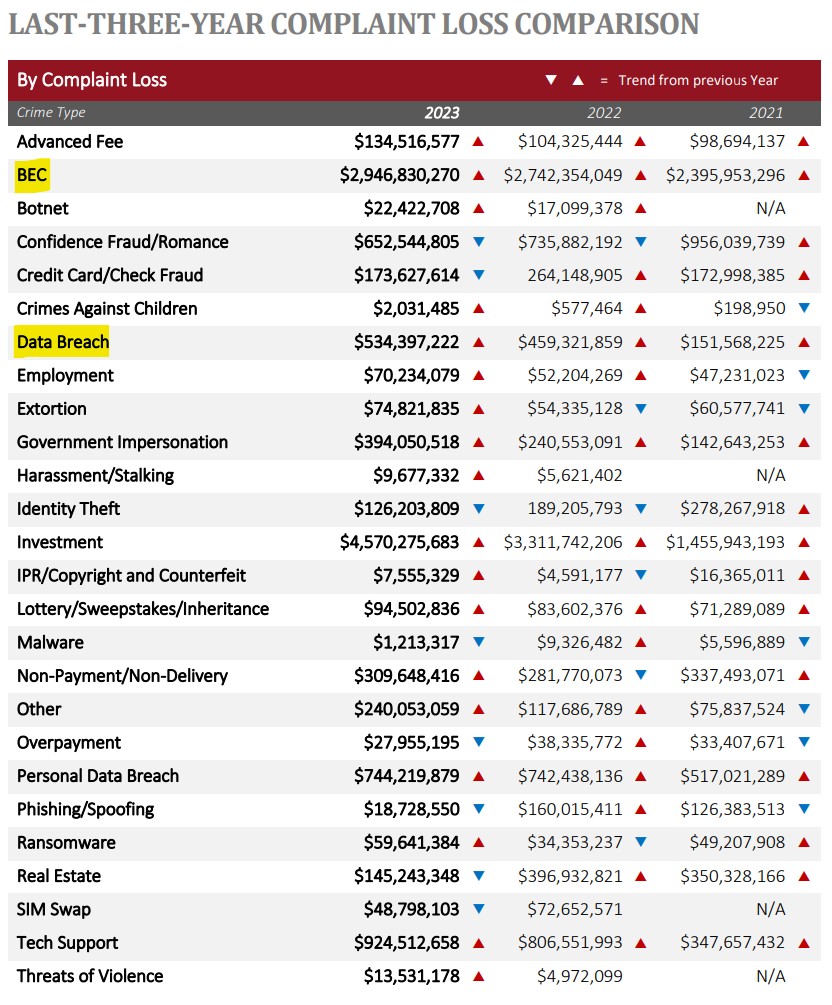
Law firms are increasingly being targeted by cyber criminals, see FBI Internet Crime Report 2023 2023_IC3Report.pdf. Note that these are only reported incidents.
Law firms will want to pay particular attention to BEC
Business Email Compromise (BEC): BEC is a scam targeting businesses or individuals working with suppliers and/or businesses regularly performing wire transfer payments. These sophisticated scams are carried out by fraudsters by compromising email accounts and other forms of communication such as phone numbers and virtual meeting applications, through social engineering or computer intrusion techniques to conduct unauthorized transfer of funds
 To read more about Business Email Compromise.
Why Law Firms Need Data Security Policies
Law firms are entrusted with their clients’ most sensitive information, including personal identification, financial records, and proprietary business information. A breach of this data can lead to severe consequences, including financial loss, reputational damage, and legal repercussions. Here are some key reasons why law firms need strong data security policies:
- Protection of Client Confidentiality: Maintaining the confidentiality of client information is paramount in the legal profession. A data security policy ensures that measures are in place to protect this sensitive data from unauthorized access and breaches.
- Compliance with Legal and Regulatory Requirements: Law firms must comply with various legal and regulatory standards that mandate the protection of sensitive data. A data security policy helps ensure that the firm adheres to these requirements, avoiding potential fines and legal actions.
- Mitigation of Cybersecurity Threats: Cyberattacks are becoming increasingly sophisticated. A data security policy outlines the necessary steps to protect against these threats, reducing the risk of data breaches and cyber incidents.
- Preservation of Reputation: A data breach can significantly damage a law firm’s reputation, leading to a loss of clients and business. Implementing a comprehensive data security policy helps build trust with clients by demonstrating a commitment to protecting their information.
Key Components of a Data Security Policy
A well-structured data security policy addresses various aspects of data protection and outlines specific measures to safeguard sensitive information. Here are some key components that should be included in a law firm’s data security policy:
Backup and Recovery Systems
Tools and procedures to regularly back up data and restore it in case of loss or corruption. This ensures that data can be recovered quickly in the event of a breach or technical failure.
Network Segmentation
Dividing the network into separate segments to limit access and contain potential breaches. This helps prevent the spread of malicious activity across the entire network.
VPN (Virtual Private Network)
Allows secure remote access and protects data transmitted over the internet. This is particularly important for law firms with remote employees or those accessing data outside the office.
Physical Controls (Tangible Measures)
Tangible security measures protect an organization’s assets and data from unauthorized access, environmental hazards, and potential breaches.
- Physical Access Controls: Locks, card access systems, and biometric systems to prevent unauthorized access to facilities or data centers.
- Surveillance Cameras: Monitor and record activity in sensitive areas.
- Secure Workstations: Positioning computer screens to prevent data exposure, locking computers when not in use, and using privacy screens.
- Secure Disposal: Procedures for safely disposing of outdated or unnecessary hardware, paper records, and storage media.
- Environmental Controls: Ensuring facilities have appropriate fire suppression, flood prevention, and climate controls to protect equipment and data.
Conclusion
Each law firm’s needs will vary based on size, industry, regulatory environment, and the type of data it handles. Thus, while the above controls serve as a comprehensive starting point, law firms should tailor their data security policies to their unique requirements and continually update them in response to the evolving threat landscape. By doing so, they can ensure the highest level of protection for their clients’ sensitive information and maintain their reputation as trustworthy and reliable legal advisors.
[/ultimate_heading][ultimate_spacer height=”40″][ultimate_heading main_heading=”ABA Model Rules of Professional Conduct Model Rule 1.1 (Competence)” spacer=”line_only” spacer_position=”middle” line_height=”1″ line_color=”#dd9933″]
Don Brown regularly conducts CLE classes for various bar associations across the country, focusing on the intersection between technology and ethical obligations. Each employee at Firefly Network Services is trained in data security and these ethical obligations. It is crucial that any support issue or recommendation complies with our clients’ ethical obligations. We think about it, so you don’t have to.
The ABA Model Rules of Professional Conduct address ethical obligations related to technology, particularly through Model Rule 1.1 (Competence), emphasizing lawyers’ duty to maintain technological competence and understand the benefits and risks of technology in legal practice.
-
Model Rule 1.1 (Competence):
This rule obligates lawyers to provide competent representation to clients, requiring them to possess the “legal knowledge, skill, thoroughness, and preparation reasonably necessary for the representation”.
-
Technology Competence:
Comment 8 to Model Rule 1.1 now explicitly states that to maintain competence, lawyers should keep abreast of changes in the law and its practice, including the benefits and risks associated with relevant technology.
-
Ethical Obligations with Technology:
Lawyers must understand the implications of using technology, including potential risks like data breaches, unauthorized access, and the need to ensure the accuracy and reliability of technology-generated content.
-
Specific Ethical Considerations:
- Client Confidentiality: Lawyers must safeguard client information from unauthorized access or disclosure, whether by themselves, other lawyers in the firm, or non-lawyer assistants, using technology.
- Supervision of Non-Lawyers: Lawyers have a responsibility to supervise the use of technology by non-lawyer assistants to ensure ethical compliance.
- AI Tools: The ABA has issued guidance on the use of generative AI tools, emphasizing that lawyers must fully consider their ethical obligations when using such technologies, including duties to provide competent representation, protect client information, communicate with clients, and supervise their employees and agents.
- Client Confidentiality: Lawyers must safeguard client information from unauthorized access or disclosure, whether by themselves, other lawyers in the firm, or non-lawyer assistants, using technology.
[/ultimate_heading][ultimate_spacer height=”40″][ultimate_heading main_heading=”Giving Back – Some of the Legal Nonprofits Who Use Our Services” spacer=”line_only” spacer_position=”middle” line_height=”1″ line_color=”#dd9933″][/ultimate_heading][rev_slider_vc alias=”marketing”][/vc_column][/vc_row]

